When mentioning Frisia, Frisian law cannot be overlooked! Old Frisian law is a special subject, however. The Old Frisian (legal) texts that have been handed down to us were written in the twelfth to fifteenth centuries. These centuries are part of an era in Frisian history known as the ‘Frisian Freedom’. During this time, Central- and East-Frisia had no ruling lord, such as a count, which meant that early medieval society continued more or less unchanged until the fifteenth century. Frisia thus had an exceptional position compared to the rest of Europe. The Old Frisian legal texts from the fourteenth and fifteenth centuries played an important role in legitimising this exceptional position of Frisia. Although these texts were written later than the ninth century, they supplement our knowledge of the law that was spoken in early medieval Frisia. This article therefore attempts to create an overview of early medieval Frisian law from the ninth century, based on early and high medieval sources and literature. It discusses the social context, the organisation of the legal system and the application of the law. Explanations of certain terms are noted at the bottom of the relevant paragraph.
Social context: the framework within which the law must be considered
Lex Frisionum
In addition to the various Old Frisian legal texts from the twelfth to fifteenth centuries, we have one early medieval legal text relating to Frisia: the Lex Frisionum. This ‘law of the Frisians’ was written down at the end of the eighth century when the Frisians came under Carolingian rule. The Lex Frisionum provides a glimpse into early medieval Frisia based on laws that were in force in the Frisian regions and had been passed down orally until then. This record of Frisian law clearly shows, in addition to the laws that were in force, which areas belonged to Frisia under Carolingian rule, namely: West-Frisia, Central-Frisia and East-Frisia. North-Frisia near Denmark was not included in the legal text because this area had not been conquered by the Carolingians. The laws and rules of Central-Frisia were used as the basis for the text of the law. Deviating laws for West- and East-Frisia were mentioned as marginal notes, and in the two Additiones Sapientum, or additions by the lawspeakers Wlemar and Saxmund.
Society
The Lex Frisionum also provides insight into the society that existed in early medieval Frisia. Firstly, the law text refers to different social classes. The social classes referred to in the Lex Frisionum are the nobility (nobiles), freemen (liberti), serfs (liti) and slaves (servi). (See our previous post ‘The unfree in early medieval Frisia’.) The different classes weren’t equal. Each class had different rights – or a lack thereof – and different compensations to pay in cases of defamation, damage to body or property, and manslaughter. In other words, not every class was of equal value. This is evident from the following passage from the Lex Frisionum on compensation for manslaughter:
Compositio hominis nobilis, librae XI per veteres denarios. Compositio liberi, librae V et dimida per veteres denarios. Compositio liti, libra II et enciae IX, ex qua duae partes ad dominum pertinent, tertia ad propinquos eius. Compositio servi, libra I et unciae IIII et dimidia. (Tit. XV: De Compositionibus wergildi)
The fine for a nobleman is 11 pounds in old pennies. The fine for a freeman 5 and a half pounds in old pennies. The fine for a serf 2 pounds and 9 ounces, of which two parts come tot he lord and the third to his relatives. The fine for a slave 1 pound and 4 ounces and a half. (Tit. XV: On wergeld fines)
The compensation for manslaughter described in the passage is referred to as wergeld or wergild*. The wergild and other compensations for injuries indicate that early medieval Frisia – like other Germanic societies – was not only a class society, but also a feuding society (vetemaatschappij). This is a society without a strong, central government that has a monopoly on the use of force, and where free-born men – the nobility – together form the constitutional state. Honour, revenge and community play an important role in a feuding society. According to non-Western sociologist Frank Henderson, honour can be regarded as ‘the right to respect’ (Nijdam 2010). An insult in word or deed, or in the worst case physical violence – damage to someone's property, rape, physical abuse, manslaughter or murder – could thus damage the right to exist of a person, or the group or family to which he or she belonged within the community. In a feuding society, the honour of an individual or group had to be preserved at all costs. An insult or physical violence could lead to revenge in order to restore the imbalance of power and restore honour. The result could lead to a chain of violence between two groups of people: a feud. A feud could be reconciled, although this could take decades. In order to prevent societal order from being torn apart, a system of compensation was needed to recompense for damaged honour.
Wound lists and compensations
In order to compensate for injuries and restore damaged honour – and thus prevent revenge and feuds – revenge could be bought off with a sum of money. One third of the Lex Frisionum consists of so-called ‘wound lists’, in which compensation for physical injuries was recorded. The lists cover compensation for literally every part of the body, starting with injuries to the head or its appendages (such as the eyes, ears, nose, etc.) and ending with the toes. In addition to compensation for physical injuries, the wound lists of the Lex Frisionum also contain some compensations for defamatory acts, such as grabbing someone by the hair (Tit. XXII. 65) or throwing someone into the water (Additio Sapientum 66). Another interesting aspect of the wound lists is their age. Based on similarities with the legal text of King Aethelbert of Kent around 600 AD, and indications that the monetary standard of the wergild seems to have been originally based on the Byzantine solidus, the wound lists appear to date back to the sixth or seventh century – broadly speaking, at the same time as the Frisians settled in the Frisian coastal area in the fifth century! (Nijdam 2023).
---
*The first part of the word wergild, ‘wer-‘, is the Germanic equivalent of the Latin vir, which means ‘man’. The ‘wer-’ part also appears in the word ‘werewolf’ (literally ‘man-wolf’) and obscurely in the word ‘world’ (Dutch ‘wereld’: literally ‘age of man’). The last part, ‘-gild’ is cognate to Dutch ‘geld’ and German ‘Geld’ (both meaning money), and the English word ‘yield’ which originally also meant ‘money’, ‘compensation’. Wergild thus translates to ‘man-money’, the compensation one would pay for manslaughter.
Thing assembly: organisation of the legal system
The thing
Law was spoken at a thing assembly. The ‘thing’, in Old Frisian thing*, was a meeting at which all kinds of different matters were discussed which related to the people living in a particular area or county, such as legal, military, political and religious matters. It is assumed that thing assemblies in early medieval Frisia were held at three levels, of which the county or pagus was the middle one. The highest level was that of the civitas. In the case of early medieval Frisia, this corresponded to a thing assembly which was held for the whole of West-, Central- or East-Frisia. The lowest level would be that of the centena or hundred (Nijdam 2021). It is, however, debated about which is meant by this term. It is possible that the term refers to a locality. Three regular assemblies were held each year. In addition, incidental assemblies could also be convened: the bodthing or ‘summoned thing’ (Dijkstra 2011). This method of meeting was not unique to the Frisians, but was common throughout the Germanic world. Well-known examples of thing meetings outside Frisia are the Alþing at Þingvellir (lit. ‘thing fields’) in Iceland and the thing meeting of the Saxons at Markelo (Netherlands) before their conquest by Charlemagne.
Many former thing sites from early medieval Frisia are known. It is assumed that these were thing sites that mostly took place at the county level. Most are known in West-Frisia: for the Rhineland, a thing site is known at Katwijk-Klein Duin; for Kennemerland, the Huldtoneel or Schepelenberg near Heemskerk; for Texel, the Sommeltjesberg; and for the Maasland, possibly the Naaldwijkse Geest. In Central-Frisia, Franeker and Dokkum were probably the thing sites of Westergo and Oostergo respectively. In East-Frisia, the fewest thing sites are known: for Federgo, possibly the Opstalsboom near Aurich (Germany) was already in use (Dijkstra 2011). Possibly, a thing site near Jever existed for the county of Rüstringen.
A striking feature of virtually all these former thing sites is their location on or near burial mounds or burial grounds. The thing had a sacred character: before a thing assembly began, the thing was demarcated and consecrated, so that a enclosed place was created in a spatial and temporal sense, which was surrounded by a special peace (thingfrethe). Anyone who broke this sacred peace by commiting violence at the thing, had to pay a high peace fine (Nijdam 2013). In this light, the placement of the thing on burial mounds or burial grounds is not arbitrary: in the pre-Christian world, ancestors played an important role in guiding and legitimising law and power. Even after their deaths, the ancestors remained part of the community.
---
*The contemporary meaning of the word ‘thing’ has acquired the meaning of ‘case’ or ‘object’ in various Germanic languages via the meaning ‘court case’ or ‘object’ discussed at a thing assembly. The semantic generalisation of the meaning of a word over time is called ‘broadening’ in linguistics.

Former known thing sites on a map of early medieval Frisia. All place names mentioned in this article have been compiled and displayed on a map. The former thing sites are marked with a red dot.
Spoken law: application of the law
Legal procedure
The Lex Frisionum also describes the general course of a legal procedure in early medieval Frisia. Later Old Frisian legal texts, such as the Oud Schoutenrecht and the Jong Schoutenrecht, confirm this information and add certain details, allowing us to form a good impression of how law was spoken at the thing in early medieval Frisia. Below is a description of how a legal procedure generally took place at the thing (Nijdam 2013):
1. A complainant brought a complaint before the judge (redieva, riuchtere, skelta) and legal expert (asega) at the thing. From the Oud Schoutenrecht and Jong Schoutenrecht, we know that the complainant (onspreker) had to swear an oath that he would speak the truth.*
2. According to the Old Frisian legal texts, this was followed by a summons (ladinge) of the accused to the thing, which was announced at his home by a court messenger (bon or banner). Once all parties were present at the thing, the judge pronounced the charge on behalf of the accuser.
3. The defendant was now given the choice of confessing or denying the charges. If the defendant confessed, he was found guilty and had to pay compensation. If the defendant denied the charges, he had to swear an oath of innocence – depending on the seriousness of the charges –, with several oath helpers swearing that the defendant was a man of honor and that he was telling the truth. The oath helpers thus vouched for the honor and reliability of the accused and did not serve as witnesses to a crime. The Jong Schoutenrecht makes it clear that the accused could also choose to take time to consider, in addition to confessing or denying.
4. If the complainant did not accept the acquittal or if the two parties could not reach agreement, recourse could be had to the feuding right or trial by ordeal. The latter was a test in which the outcome of a legal case was placed in the hands of higher powers — in pre-Christian times, the gods; in Christian times, God (see further under Trial by Ordeal).
In the early middle ages, it was possible to swear oneself free of a charge. This may seem simple or backward to us, but the procedure should not be taken lightly. First of all, swearing an oath must be seen against the backdrop of a feuding society: if someone committed perjury, they lost their honor (:right to exist) and credibility in the face of their community. This also applied to the oath helpers who had bound themselves to the accused by their oath. The oath helpers were thus faced with the decision of whether they wanted to put their honor on the line for the accused. Secondly, the oath was drawn up by the complaining party. The oath had to be pronounced exactly as formulated by the accused, otherwise it was considered invalid. Related to this was the fact that the thing had a sacred aura: perjury was therefore also considered sacrilege. In early medieval Frisia, one could swear an oath on various objects, namely: on relics (LexFr. Tit. X), on clothing (Tit. III. 5.), and on possessions (fia-eth)*, such as cattle, money, or a sword (Nijdam 2013).
Some archaeological finds from Friesland and Groningen in the Netherlands are known to have been used in legal procedures. First of all, finds of so-called ‘oath swords’ have been made in Arum (Friesland) and Rasquert (Groningen). It is assumed that the two small swords, made of yew wood and whale bone respectively, were used to swear oaths upon or to summon people to appear in court (Looijenga 2003). The first explanation suggests that, in addition to a real sword, a symbolic sword – possibly in the absence of a real sword – was considered sufficient. Both oath swords also bear runic inscriptions: the inscription from Arum reads edæboda, which translates as ‘oath harbinger’, and the inscription from Rasquert ek:umædit:oka, which translates as ‘I, Oka, have not become angry/mutilated’ (Looijenga 2003). The inscription from Arum describes the role of the oath sword and the inscription from Rasquert describes the purpose – or, in our opinion, the enchantment – of the legal procedure: to prevent people from resorting to violence in a feud. Both swords are dated to the late eighth century.
Furthermore, a whale bone staff with runic inscriptions was found in Bernsterburen (Friesland). One theory is that this type of staff was an attribute of a judge (Looijenga 2003). The staff consists of seven broken parts with a T-shaped handle that ends in a stylized horse's head at both ends. The runes on the staff read as follows: tuda æwudu (or æludu) kiusþu tuda. Runologist T. Looijenga suggests the translation ‘Tuda, Aludu you must choose Tuda’, but also indicates that a literal translation of the individual words could be ‘people, witnesses/oath helpers you must choose, people’ (Looijenga 2003). Based on the latter translation, it can again be interpreted as an enchantment to ensure that legal proceedings run smoothly. The staff is dated to around 800 AD.
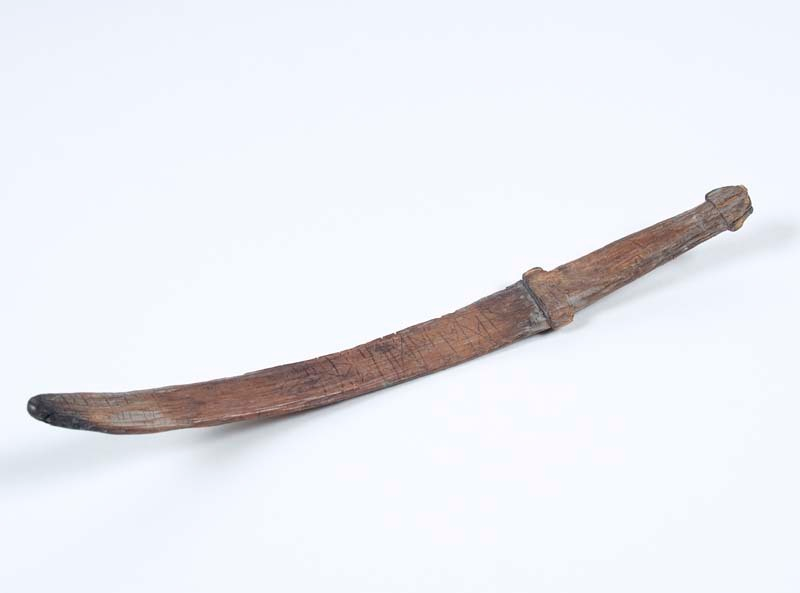
The 'oath sword' from Arum with the runic inscription edæboda. Fries Museum, collection number 80E-1.

Whale bone staff with runes from Bernsterburen. Fries Museum, collection number 44B-2.
Trial by ordeal
The complainant could appeal to a trial by ordeal. Various ordeals are known. One of these was the trial by fire. This involved the accused walking over hot plowshares, holding a red-hot iron bar, or placing his hand in boiling water. The point of these trials was that the wounds had to heal within a certain period of time. If the wound became infected, the accused was found guilty.
Another type of ordeal was trial by combat: the judicial combat (strid, kamp, thingkampene). In a judicial combat, both parties could enter the arena or – at least in the twelfth century – hire a professional fighter (kempa).* The procedure for a such a battle is described in the Oud Schoutenrecht from the twelfth century: if it came to trial by combat, the two kempan swore an oath of combat (strideth) and then entered the arena (kampstal or ham). The dimensions of the arena were ‘tria ende sextigha foeta breed’ (sixty-three feet wide) on all sides, which according to legal historian Han Nijdam is approximately 19 meters (Nijdam 2008, 170). Each kempa was given two swords, a shield, and a spear. During the battle, the judge, asega, and referees (gretwerderan) were present. Depending on the offense being fought over, the battle could last a maximum of three days, with probably one round per day. The battle was won by the kempa who was the first to inflict a bleeding wound on his opponent (Nijdam 2023b). Equivalents of the Frisian judicial combat also exist in Scandinavia: the hólmgang (Ciklamini 1963).
---
*The Old Frisian terms redieva and riuchtere literally translate to ‘counsel-giver’ and ‘judge’. The term skelta literally means ‘debt-sayer’ (skelt = debt (Dutch: schuld)). The term asega literally means ‘law-sayer’ (a-sega). The component a originally meant ‘law’, ‘divine right’. The component sega is related to the modern English word ‘to say’.
Fia-eth literally means ‘cattle oath’. The Old Frisian word fia is cognate to Dutch ‘vee’, German ‘Vieh’ and English ‘fee’, which originally also meant ‘cattle’. Cattle was seen as a measurement of wealth in the early middle ages. This is reflected in the ‘fehu’ rune from the futhark rune alphabet.
The Old Frisian word kempa derives from the Proto-West Germanic *kampijo (warrior) or Latin campio (warrior). It is cognate to the Old English word cempa (warrior) en the contemporary English word ‘champion’.
Conclusion
It is necessary to have knowledge of the society in which early medieval law took place, to understand early medieval law itself. Early medieval Frisian society was characterized by social classes and violence, in which wounded honor could lead to feuds. The law was designed to prevent feuds from happening: the perpetrator compensated the victim (or the victim's family) directly in the form of wergild or compensations for defamatory acts in word or deed. Wounded honor was restored – as much as possible – at the thing. In a judicial procedure, the defendant’s honour was invoked with regard to his community: oath helpers who ensured the reliability and good character of the defendant were drawn from the community and were needed to acquit oneself in the case of serious charges. If this wasn’t accepted by the complainant, the charge was placed in the hands of fate during a trail by ordeal. The location of the thing assembly on or near burial mounds or burial ground, the consecration of the thing assembly, and leaving the outcome of a court case in the hands of higher powers (ancestors, gods or God) show that law was considered sacred: divine order reflected worldly order. This was the purpose of law. The law had to ensure that society maintained peaceful and stable in a violent early medieval world. Law created order out of chaos.
During the Carolingian weekend at PreHistorisch Dorp in Eindhoven, The Netherlands in April 2026, the re-enactment groups Monetarii Dorestatii and Novum Milites Francorum staged the trial ‘For manslaughter during a riot’ as described in the Lex Frisionum (Title XIIII. De Homine in turba occiso). During the trial, a trial by ordeal is used to determine who must pay wergild for manslaughter that took place during a riot, wherein the perpetrator is unknown. The perpetrator is identified by drawing lots from a reliquary dedicated to a saint.
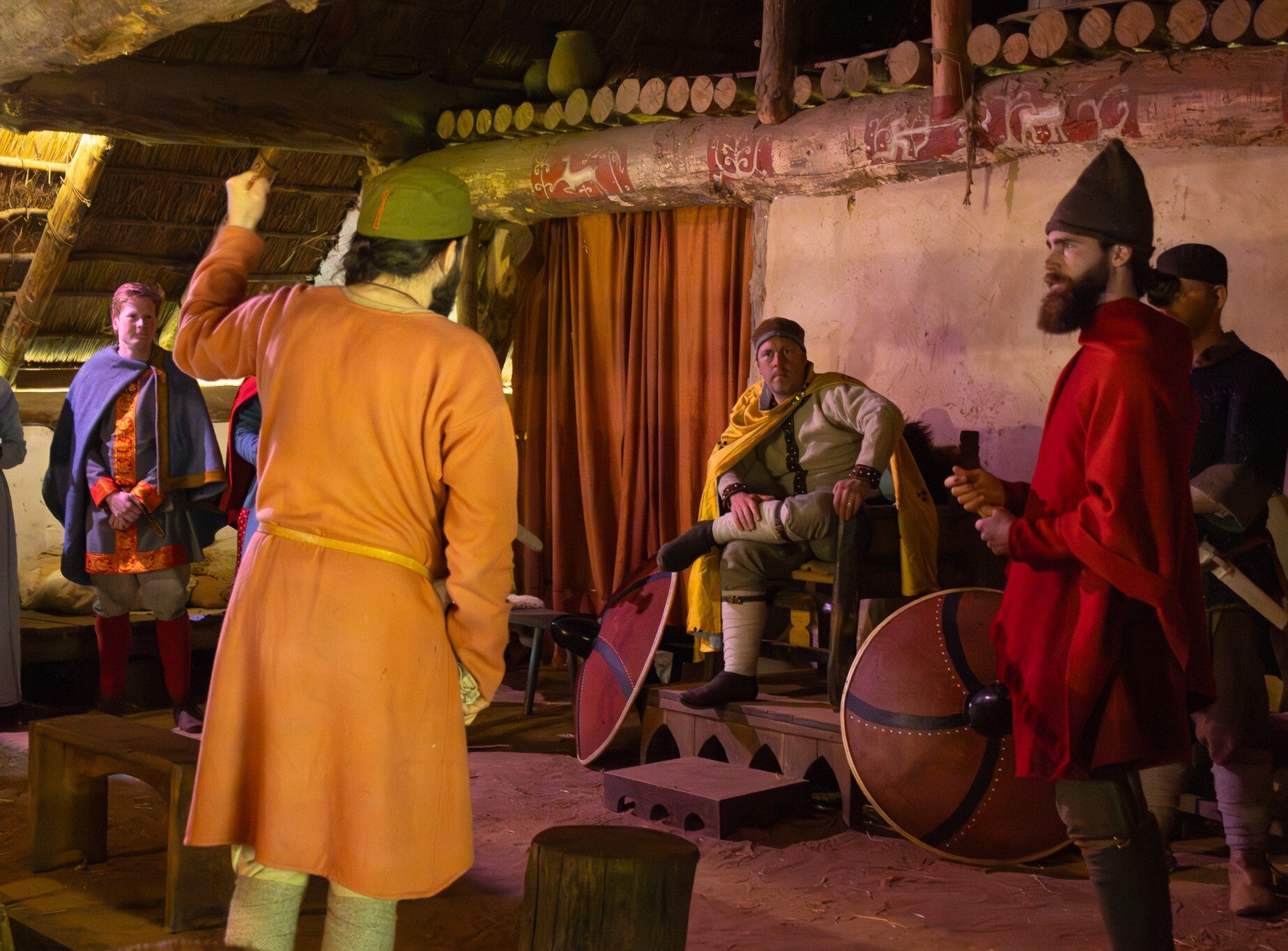
1. The complainant files a complaint.
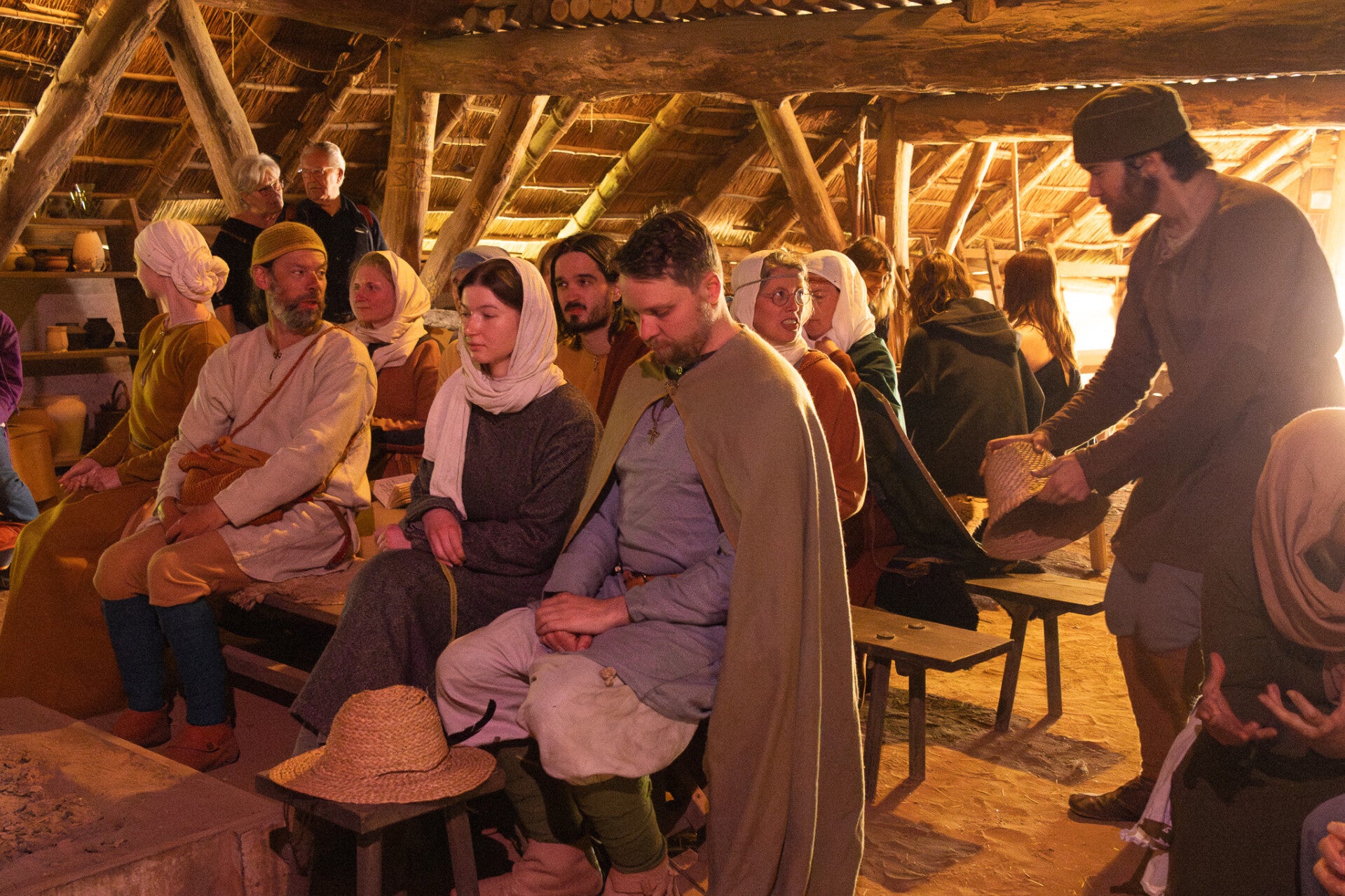
2. All the villagers have come to the thing assembly. All the parties have been summoned.
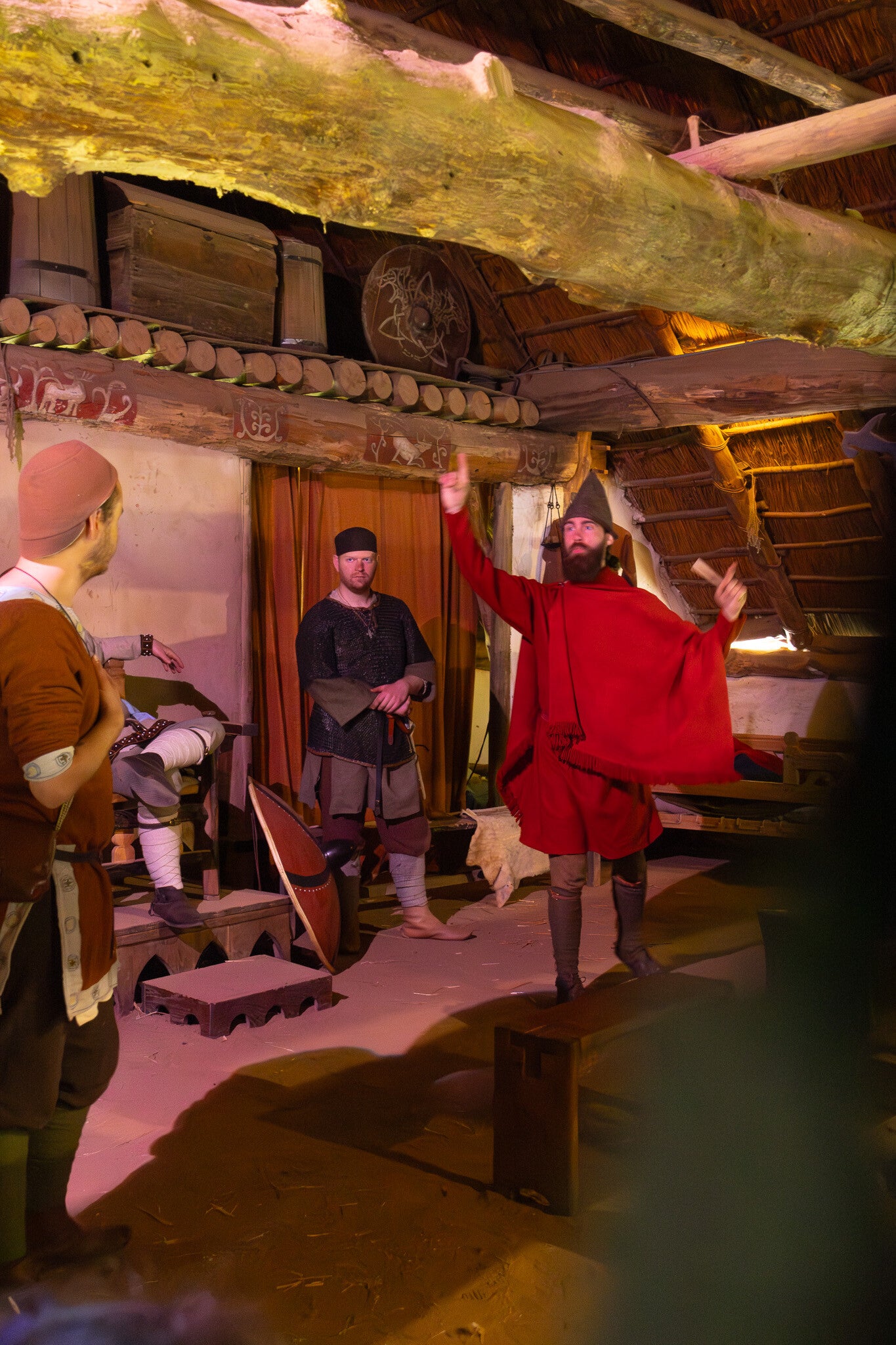
3. The asega (law speaker) recites the law of the land.
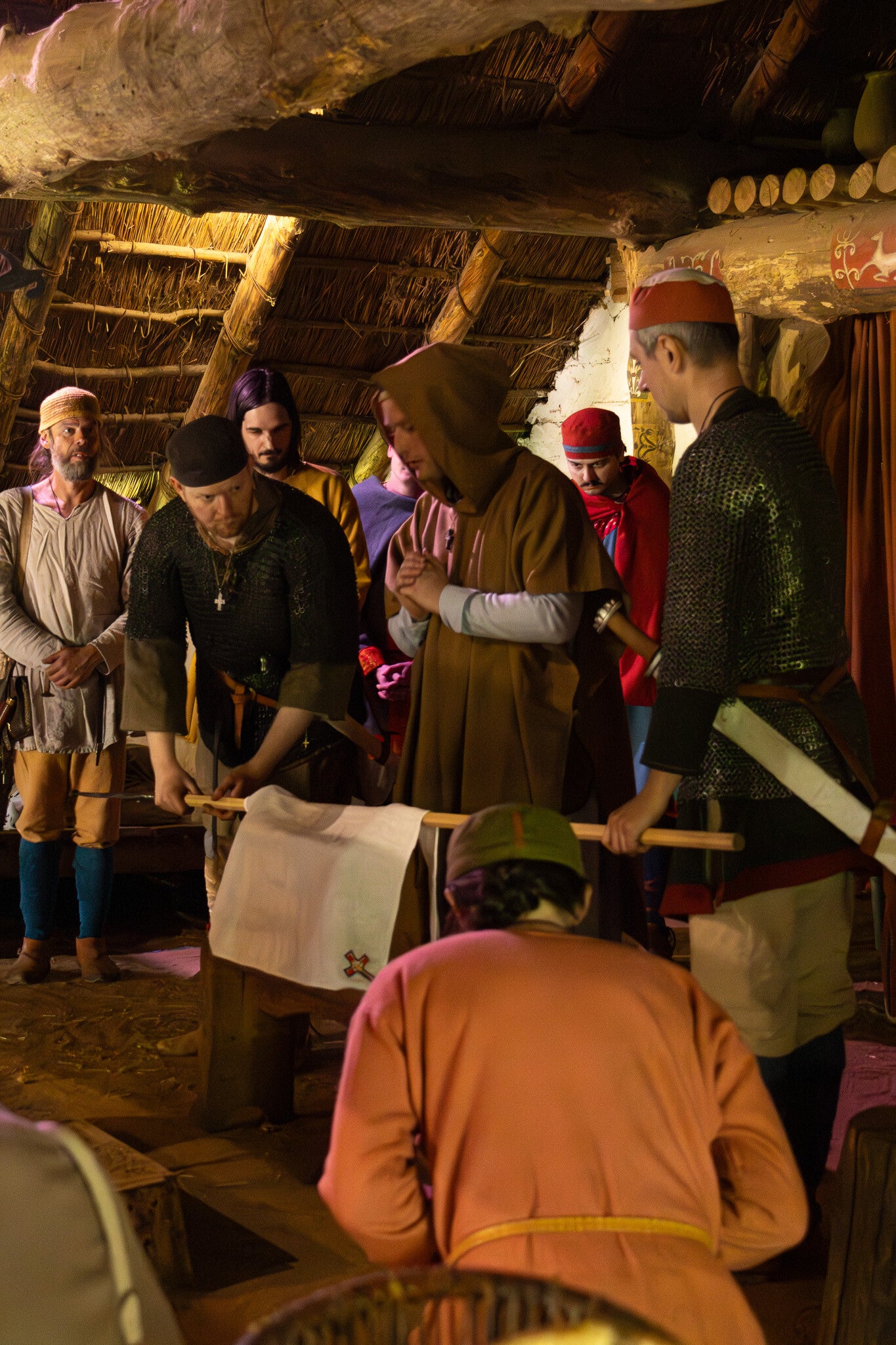
Trial by ordeal: relics are summoned to swear the oath upon and draw lots from, after the complainant refused to accept the oath of acquittal.
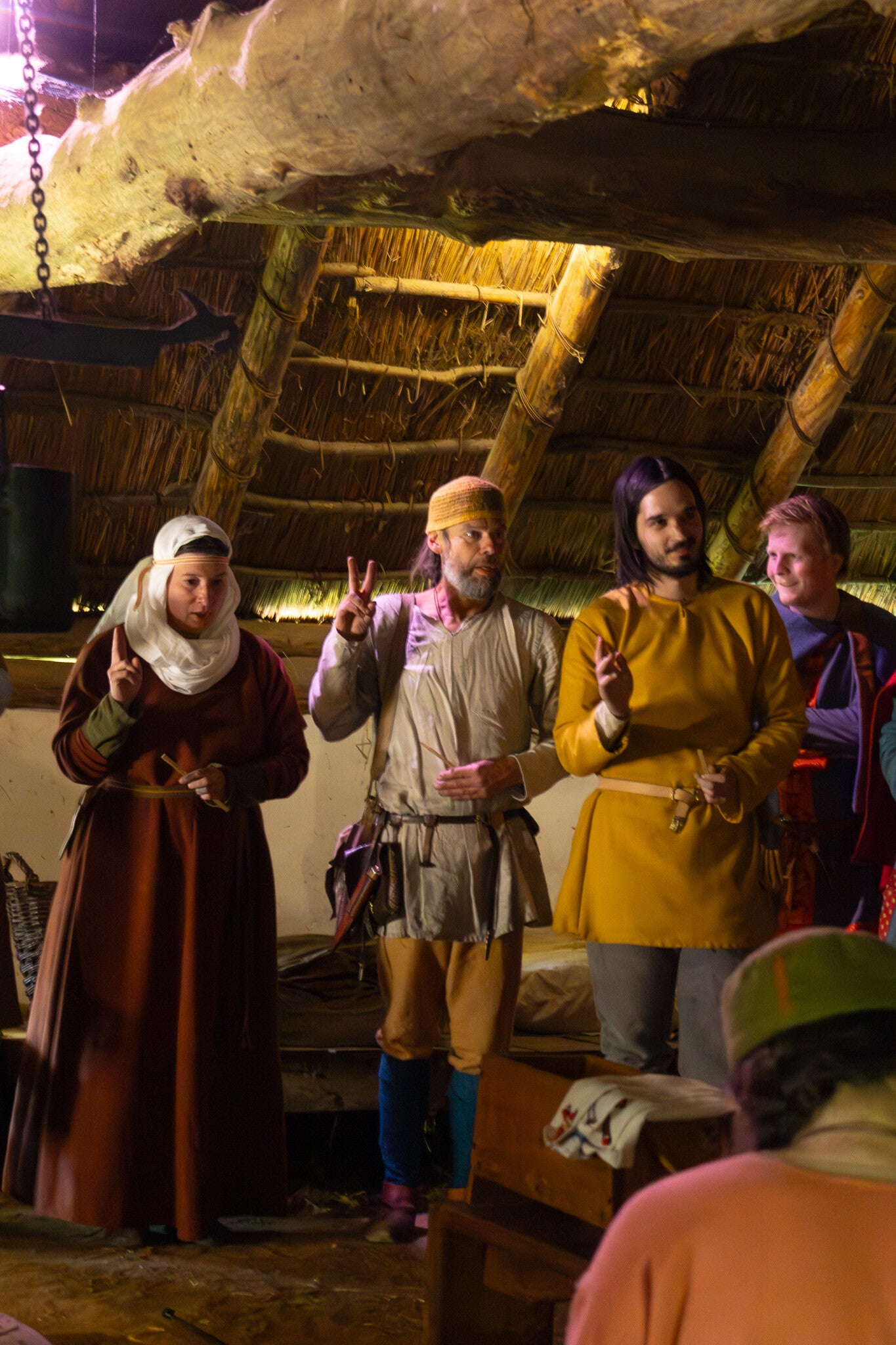
5. The defendants swear the oath (in the past, the oath was literally sworn on the relics).
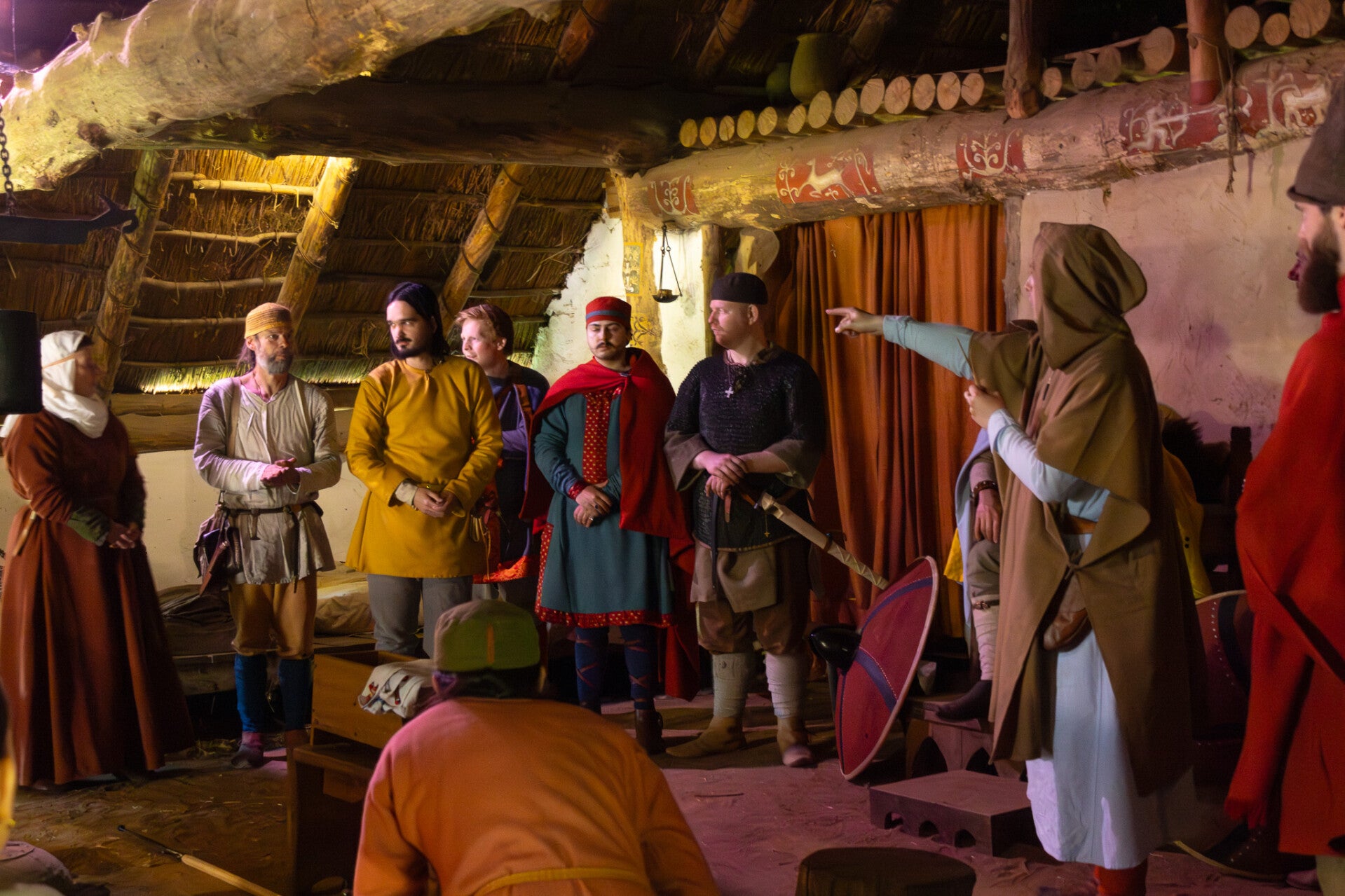
6. God’s judgement has found a guilty party.
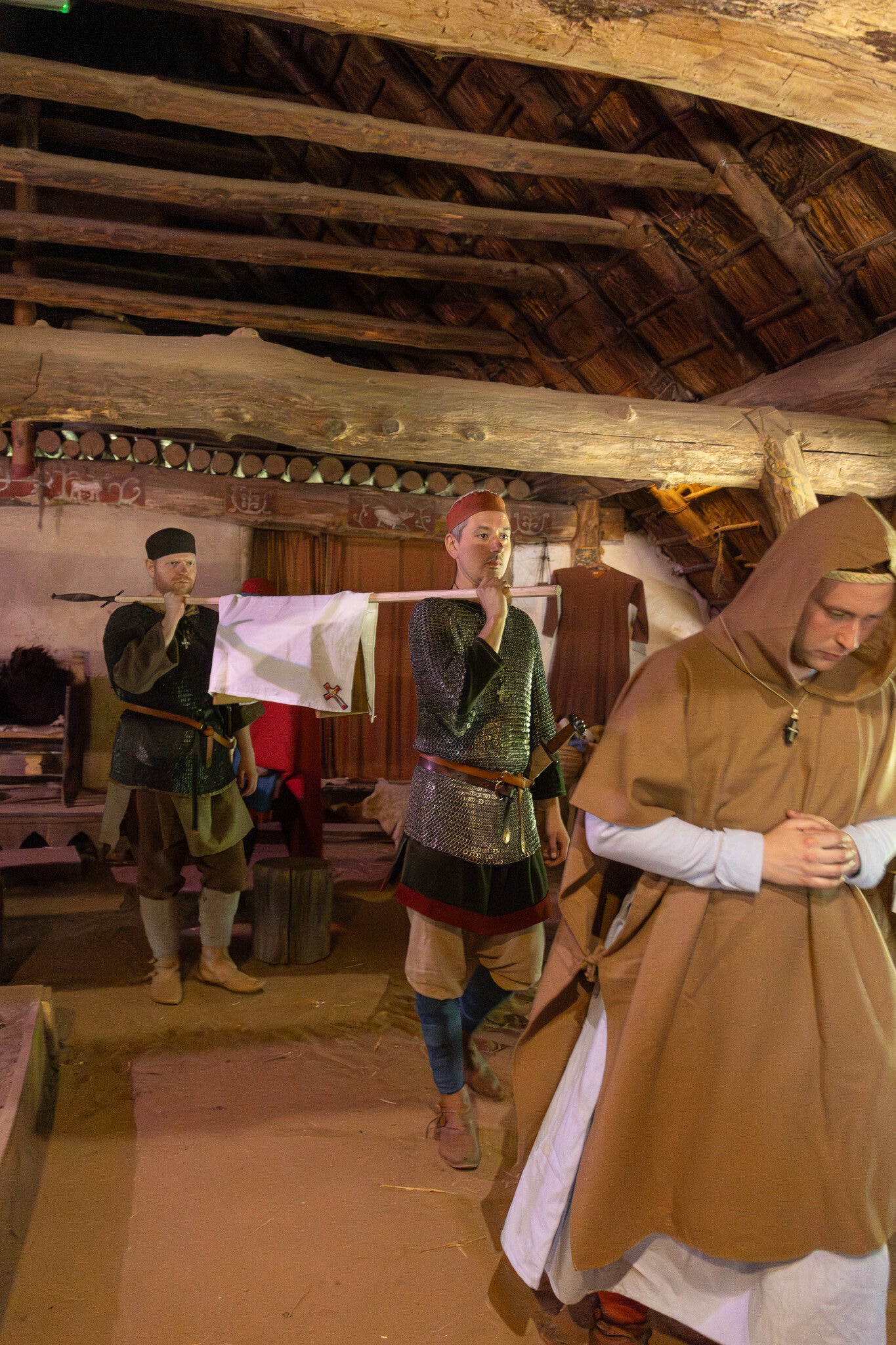
7. After the trial, the relics are taken away.

Impression of a hólmgang in Scandinavia. The judicial duel, and the arena in which it was fought, looked similar in Frisia.
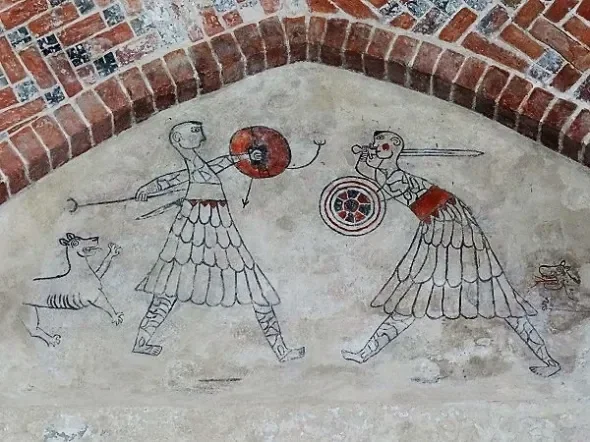
Image of two combatants fighting a judicial combat on the church in Westerwijtwerd (Groningen). This image depicts high medieval Frisians.
Sources
- Ciklamini, M., ‘The old Icelandic duel’, Scandinavian studies 35:3 (1963) 175-194.
- Dijkstra, M., Rondom de mondingen van Rijn en Maas (Leiden 2011) 298-301.
- (Nijdam 2010) Nijdam, H., ‘Belichaamde eer, wraak en vete. Een historisch- en cognitief-antropologische benadering’, Tijdschrift voor Geschiedenis 123:2 (2010) 192-207.
- (Nijdam 2023b) Nijdam, H., D. Spiekhout en C. Van Dijk, ‘De culturele betekenis van het tweesnijdende zwaard in middeleeuws Frisia’, Vrije Fries 103 (2023) 146-163, aldaar 148-158.
- (Nijdam 2022) Nijdam, H., ‘De middeleeuwse Friese samenleving. Vrijheid en recht’ in: D. Spiekhout (red.), Vrijheid, vetes, vagevuur. De middeleeuwen in het noorden (2022) 21-31.
- (Nijdam 2023) Nijdam, H., J. Hallebeek, H. De Jong, Frisian land law. A critical edition and translation of the Freeska Landriucht (Leiden 2023) 3-11.
- (Nijdam 2021) Nijdam, H., ‘Law and political organization of het early medieval frisians (c. AD 600-800)’ in: J. Hines en N. IJssennagger-van der Pluijm (red.), Frisians of the early middle ages (2021) 137-170.
- (Nijdam 2008) Nijdam, H., Lichaam, eer en recht in middeleeuws Friesland (2008) 53-62, 67-70, 74-76, 149-151, 165-166, 169-173.
Websites - Lex Frisionum, Tekst en vertaling door K. Nieuwenhuijsen: http://www.keesn.nl/lex/lex_nl_text.htm
- Viking Answer Lady, Hólmgang and Einvigi: Scandinavian forms of the duel: https://www.vikinganswerlady.com/holmgang.shtml (geraadpleegd 15 november 1998).
Reactie plaatsen
Reacties