One of the best-known and most sought-after goods produced and traded by the early medieval Frisians was high-quality textile: so-called Frisian cloth. In the early middle ages, various types of textile were produced, mainly from wool and linen. In the water-rich coastal areas of Frisia, the early medieval Frisians partly supported themselves by keeping sheep, whose wool served as the raw material for Frisian cloth. Frisian cloth distinguished itself from other types of textile through a special weaving technique known as ‘broken diamond twill’, which made the fabric elastic. Frisian cloth was also rich in wool grease, which made it warm and water-repellent. These remarkable properties made Frisian cloth highly prized as pallia Fresonica, or Frisian cloaks.
Women’s work
Frisian cloth was produced by women. Finds of spindle whorls, weaving cards, wool combs and needles as grave goods in women’s graves show that women of every social class were involved in the cloth-making industry in one way or another. The word for ‘woman’ in early medieval Germanic languages – Old Frisian, Old Saxon and Old English wīf, Old High German wīb and Old Norse víf – is even etymologically related to the word ‘weave’ (OE wefan, OF *weva, OS *wevan, OHD *weban, ON vefa) (Huisman 2008)! Spinning, weaving and sewing were all tasks through which a woman in early medieval Christian societies – for example, the Carolingian Empire – could demonstrate her feminine virtue and piety: something that is also reflected in ninth-century depictions of Mary. Women of low or servile status produced the bulk of the cloth, whilst women of high status oversaw and organised the process. The Lex Frisionum shows that the compensation for injuring the hands of a woman weaving Fresum – Frisian cloth – was a quarter higher than for other women of the same rank (Lex Fr. Haec iuditia VVlemarus dictavit, 23–24). Women thus played a significant and important economic role in the production of Frisian cloth, with women of status directing the work.
Textile workshops
Textile production occured mainly in textile workshops, or on dependent farms where women were responsible for a quota of textiles each year as payment to the estate holder. Cloth, such as Frisian cloth, was sometimes levied as a tax, as was the case with the Abbey of Fulda, which in the ninth century levied 855 Frisian cloaks annually as tax (Garver 2009, 262)! The textile workshops where the cloth was made were known as gynaecea, piseles or screona. Finds of such textile workshops have actually been discovered in the terp-mound area in the northern Netherlands and Germany! Based on finds of weaving weights in pit-houses (small, semi-subterranean structures) in various Groningen and East-Frisian terp-mound villages – such as Leens, Rasquert, Westeremden, Dunum, Dalem and Wittmund –, it is assumed that these buildings served as textile workshops in the terp-mound area. Such pit-houses were often part of a farmstead. However, textile workshops the size of entire sod houses are also known, for example from Hatzum. The importance of textile workshops is evident, again, from the Lex Frisionum, which states that the destruction of a weaving hut (screona) during a feud was punishable by death, unless one compensated oneself tot the owner of the weaving hut by paying his wergild (Lex Fr. Additio Sapientum Tit. I.3). The production of Frisian cloth thus appears to have been a large-scale and important activity!
Well then, Frisian cloth was a defining feature of early medieval Frisia, and its production played a significant role. For this reason, we decided to include the craft of weaving in our re-enactment depiction. Our members Liesbeth, Marijke and Tineke will be looking after this craft, and the new warp weighted loom! Our loom still needs to be set up, and will be photographed in detail in the future!
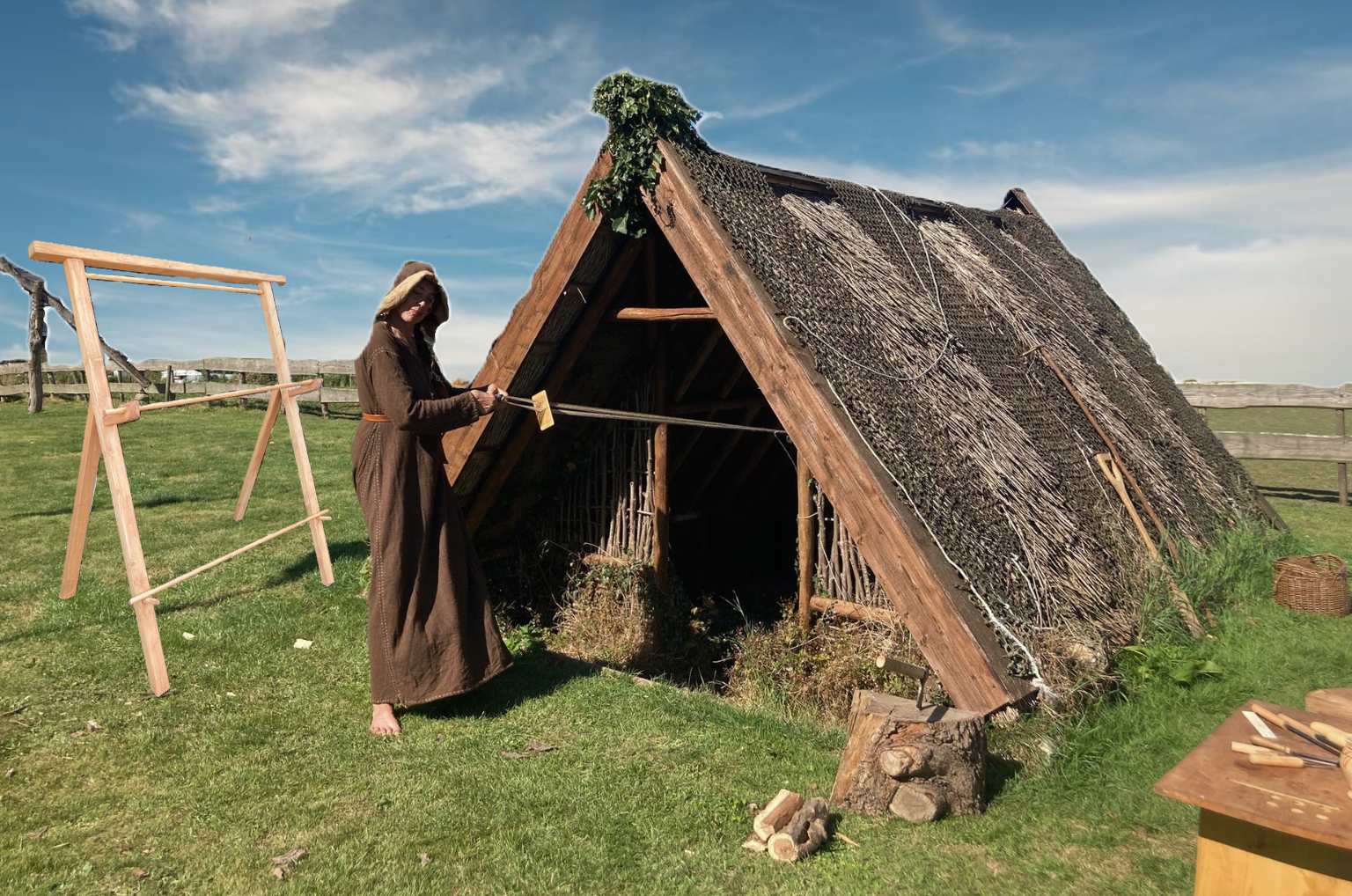
An early medieval Frisian weaving woman at a weaving house. The frame of our new weight loom stands unstrung next to the gynaeceum.
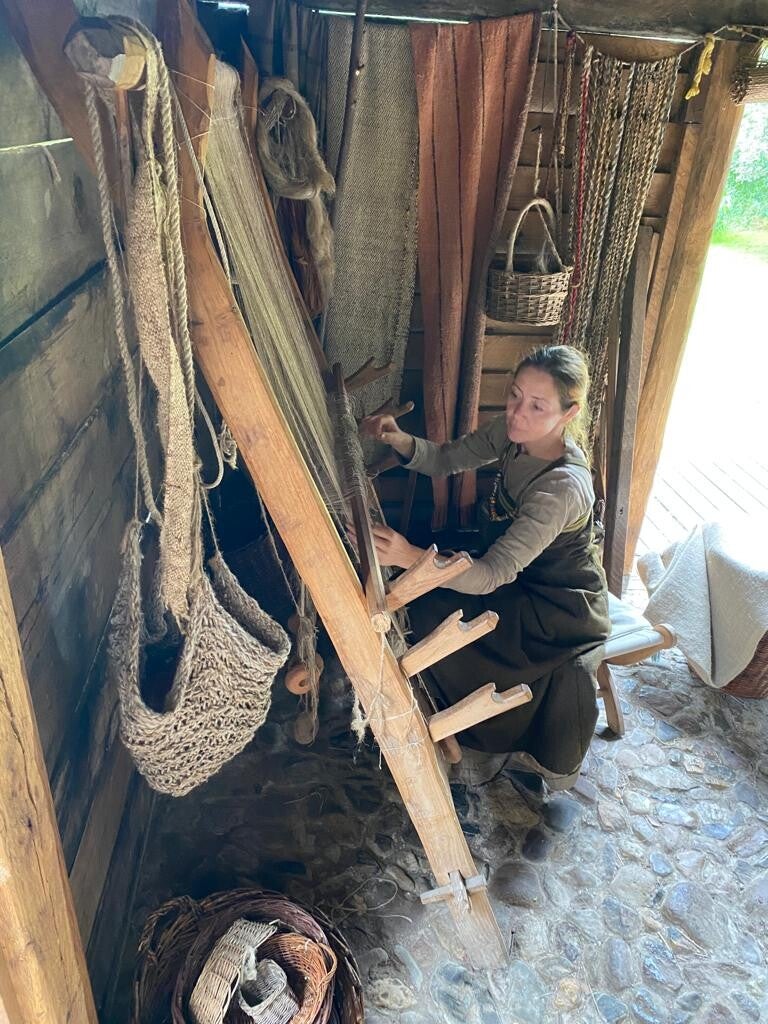
A weaver at work on a working loom.
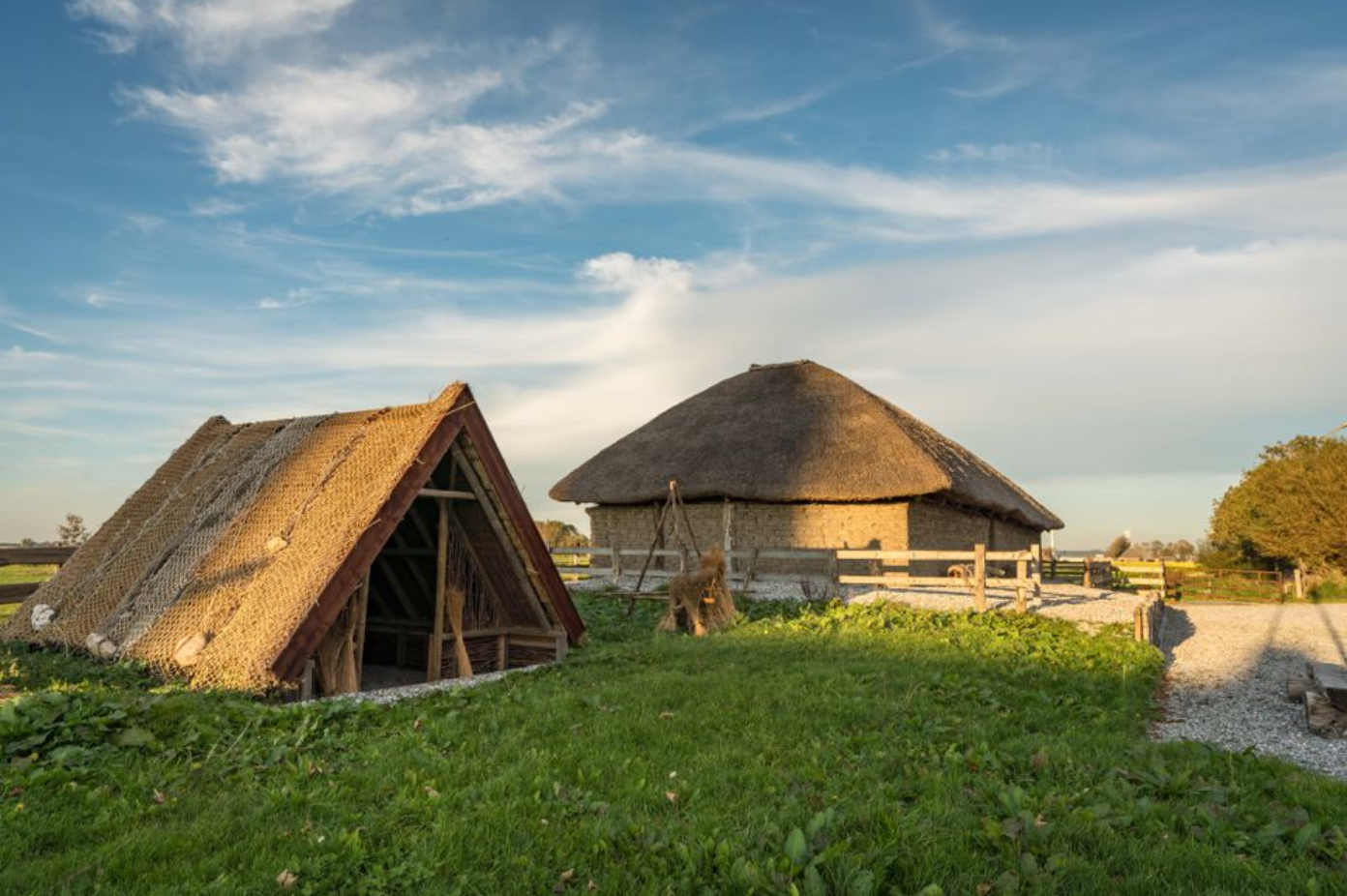
Example of a Frisian farmstead with pit-house in Firdgum, Friesland.
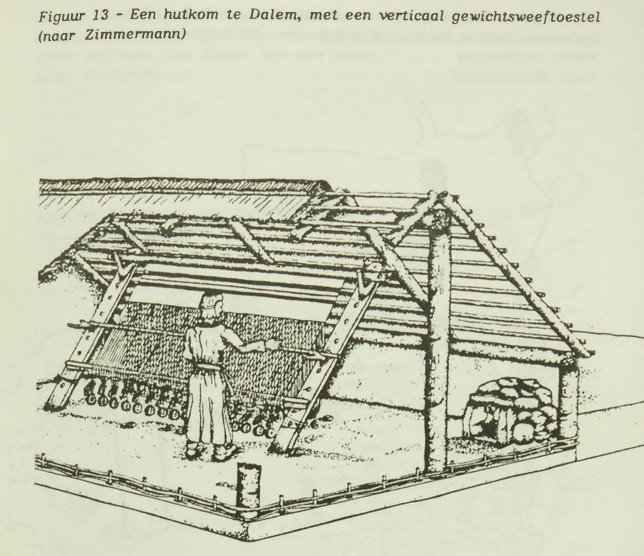
An impression of a pit house used as a weaving house. The illustration is based on the excavation of the pit house in the now-vanished East Frisian terp-mound village of Dalem. Source: Van Gorp, Friese mantels 89
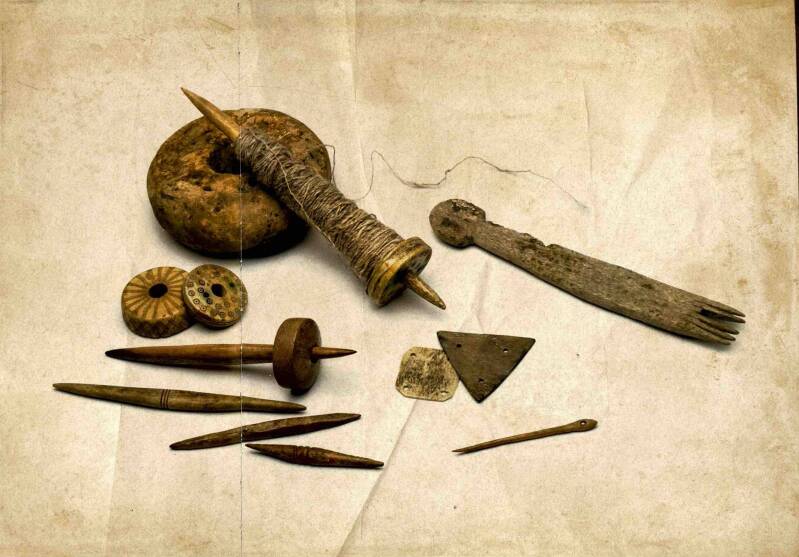
Weaving tools comprising a loom weight, spindles with spindle whorls, weaving cards, a wool comb and a needle, dating from before 1000 AD. Fries Museum, Leeuwarden | Collection of the Koninklijk Fries Genootschap. Source: Stoter and Spiekhout, Wij Vikingen 68–69.
Sources
- Garver, V.L., Women and aristocratic culture in the Carolingian world (New York 2009) 224-233.
- Gorp, P.J.M. van, Friese mantels. Een wolnijverheid van voor Christus tot in de 11e eeuw (Tilburg 1986) 34-92.
- Huisman, R., ‘Narrative sociotemporality and complementary gender roles in Anglo-Saxon society: the relevance of wifmann and wæpnedmann to a plot summary of the Old English poem Beowulf’, Journal of the Australina early medieval association 4 (2008) 125-137, aldaar 141.
- Knol, E., en D. Spiekhout, ‘Dagwerk op de Friese kwelder’ in: Stoter, M., en D. Spiekhout, Wij Vikingen. Friezen en Vikingen in het kustgebied van de Lage Landen (Leeuwarden 2019) 56-73, aldaar 68-69.
Websites
Lex Frisionum, Text and translation by K. Nieuwenhuijsen: http://www.keesn.nl/lex/lex_en_text.htm
Reactie plaatsen
Reacties