Want to throw stones over a long distance? Use a sling! During Antiquity, the use of the sling was widely depicted in art and literature, and evidence of it’s use is found in archaeological finds. Various peoples, such as the Greeks, Romans, ‘Germanics’ and ‘Celts’, are known to have used this ancient weapon. But what was about their use in the early middle ages? This post will cover the use of slings in the ninth century.
What is a sling?
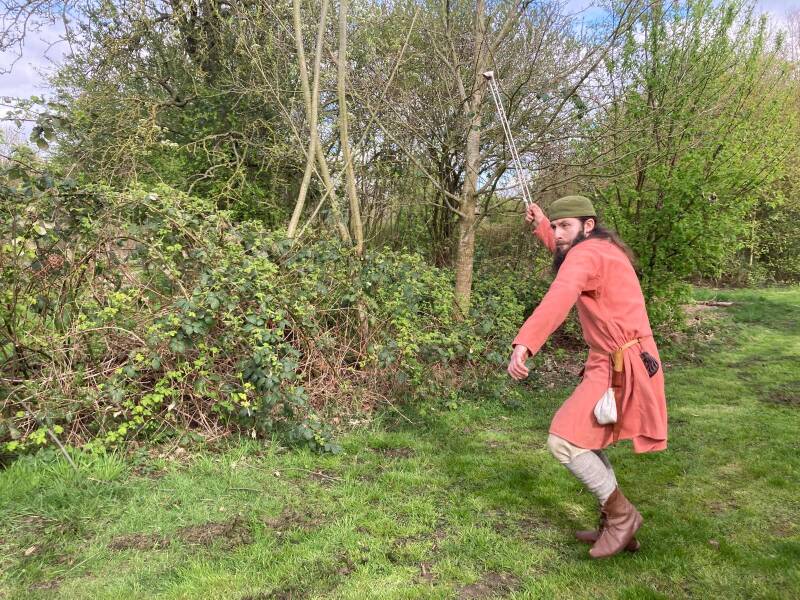
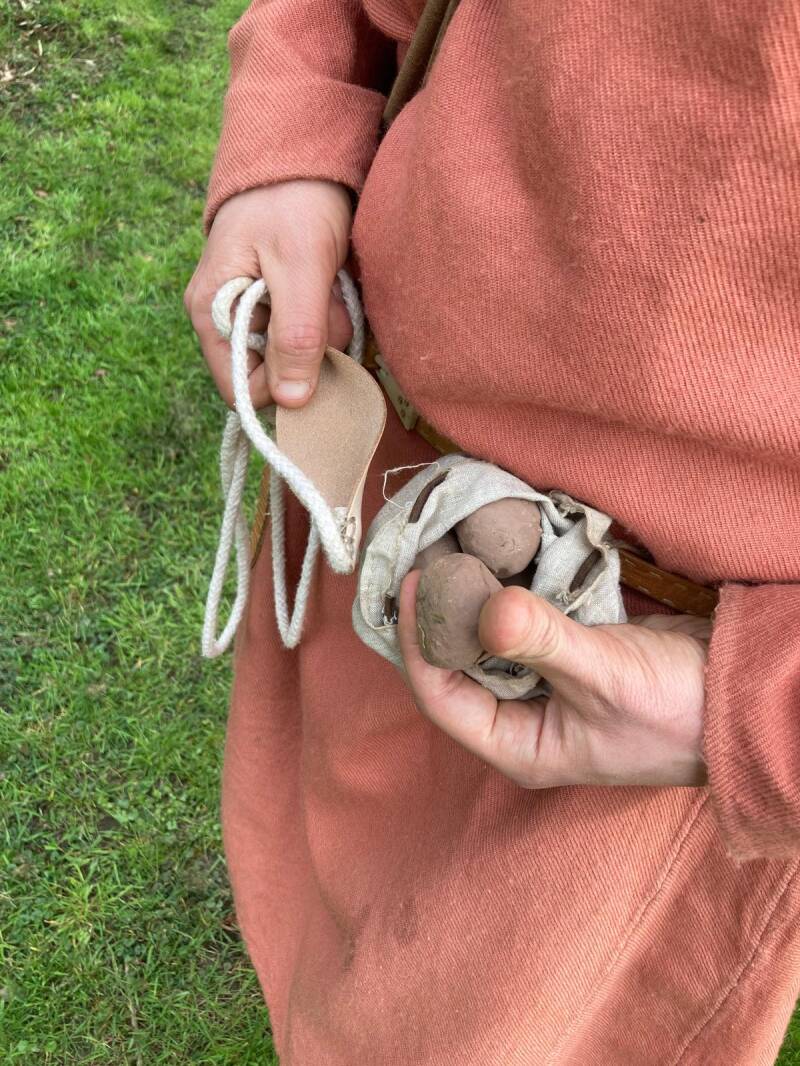
A sling is a weapon used to hurl stones over long distances. It consists of two ropes attached to a pouch: one end of a rope has a loop that can be placed over a finger or the hand, whilst the other end has a knot that is released when the stone is thrown. A sling can achieve ranges of between 200 and 350 metres, meaning it surpasses the maximum range of the medieval longbow (300 metres) (Dohrenwend 2002). In addition to its greater range, a sling is less affected by weather changes than a bow, and ammunition is available almost everywhere in the form of pebbles.
Use
Slingers were used for various purposes. The best-known use of the slinger is as a weapon in warfare. The use of the sling on the battlefield is known from Antiquity (including the Frisian Revolt at Castellum Flevum in 28 AD) and the fourteenth century (including Henry VII’s campaign to Italy in 1310–1313). The use of slings in early medieval warfare is not yet known from written records or archaeological finds. It is, however, known that slings existed and were used in the early Middle Ages, namely for protecting crops and livestock. In a marginal decoration on the Bayeux Tapestry, an agricultural scene is depicted in which people are ploughing, harrowing, sowing, and scaring away birds from the fields by throwing stones with a sling. Furthermore, in the Stuttgart Psalter, the biblical David is depicted as a shepherd with a sling defeating the giant Goliath. It is also believed that the sling served as a hunting weapon for hunting small game (Dohrenwend 2022).
Staff sling
Another type of sling used exclusively as a military weapon was the staff sling (also known as a fustibalus). This tool is similar to the sling, except that the two ropes with the pouch are attached to a stick or staff. The staff sling had a similar range to a hand sling, but was easier to learn and could throw heavier stones. The weapon probably dates from the fifth or sixth century, when it was used in the Western and Eastern Roman armies. Once again, there are no known finds or references from the early middle ages regarding the use of this type of sling. However, it is known from the Chronica Majora that – yes indeed – the Frisians used the staff sling to hurl stones over the city walls during the Siege of Damietta in the First Crusade in the 13th century.
Coastal Defence
The use of the sling in the early middle ages to protect crops and livestock is only a small step away from its use on the battlefield. Might the weapon also have been used by servicemen in the Frisian coastguard or lantweri? Who knows... (see also our previous post ‘Light the beacons! - Early medieval Frisian coastal defence’) In any case, we gave throwing stones with the sling a go. Although it proved to be a particularly entertaining pastime, we came to the conclusion that we couldn’t yet use it to drive off invading Vikings...
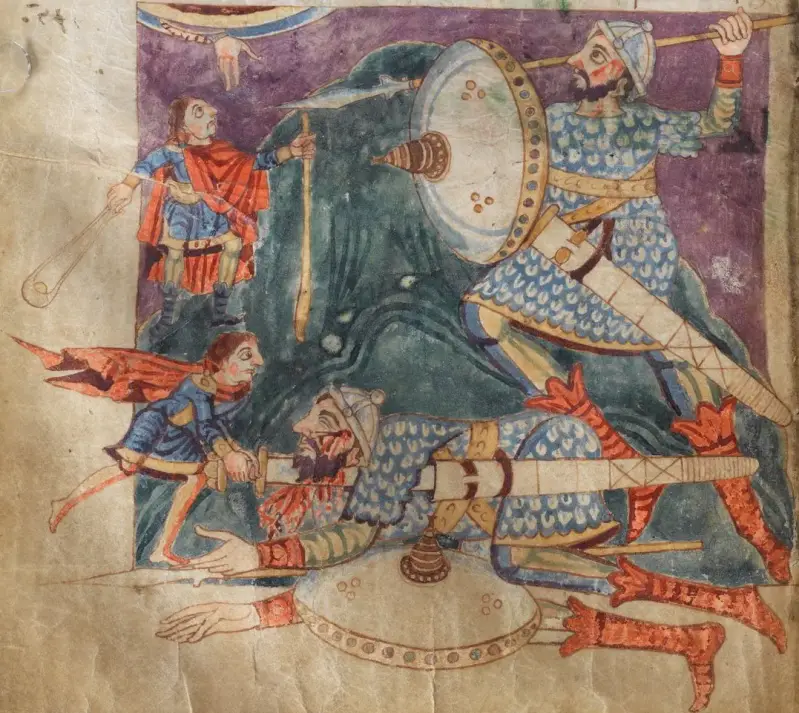
Stuttgart Psalter, Paris, France, ca. 801-850, Folio 158v, Cod.bibl.fol.23, Württembergische Landesbibliothek, Stuttgart.
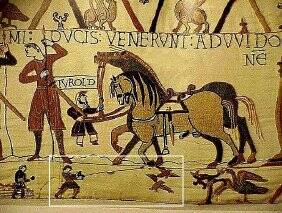
Detail on the Bayeux Tapestry, slinger scares off birds.
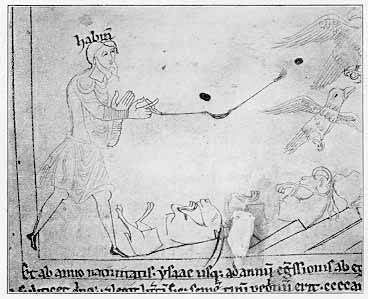
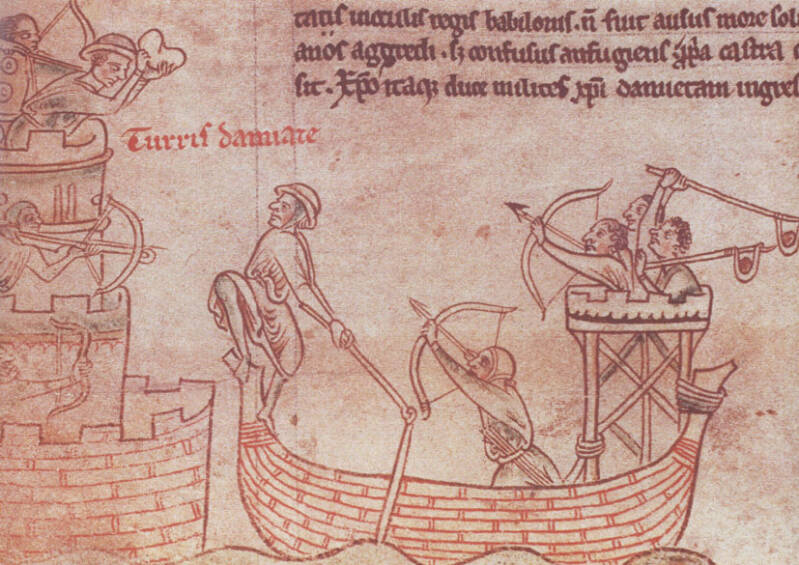
Chronica Maiora II, Saint Albans, England, ca. 1240–53. Folio 59v, MS 16II, Parker Library, Corpus Christi College, Cambridge.

Sources
- Dohrenwend, R.E., ‘The sling. Forgotten firepower of Antiquity’, Journal of Asian Martial Arts 11:2 (2002) 28-49, aldaar 29-33.
- Regia Anglorum – Arms and Armour [4] – Missiles, https://regia.org/research/warfare/bow.htm
Pictures
- Chronica Majora by Matthew Paris, Matthaei Paris Chronica Maiora I, Siege of Damietta, https://warfare.ueuo.com/13/Chronica_Majora-Siege_of_Damietta.htm
- Manuscript Miniatures, Stuttgart Psalter, https://manuscriptminiatures.com/4868/13197#image
Reactie plaatsen
Reacties